Interview Cake
Quick reference
Costs
| Worst Case | |
|---|---|
| space | O(n * k) |
| insert | O(k) |
| lookup | O(k) |
| delete | O(k) |
n is the number of strings in the trie, and k is the length of the longest one.
A trie (pronounced "try"), also called a prefix tree, is a tree that stores strings one character at a time, so strings that start with the same prefix share the same path from the root. That makes tries great for prefix searches like autocomplete: inserting or looking up a string of length k takes O(k) time, no matter how many strings the trie holds.
Here's a trie that stores "David", "Maria", and "Mario":
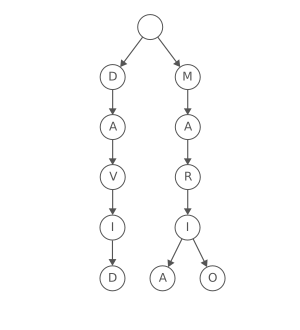
Notice that we only store "Mari" once, even though it appears in two strings: "Maria" and "Mario".
Strengths
- Sometimes Space-Efficient. If you're storing lots of words that start with similar patterns, tries may reduce the overall storage cost by storing shared prefixes once.
-
Efficient Prefix Queries. Tries can quickly answer queries about words with shared prefixes, like:
- How many words start with "choco"?
- What's the most likely next letter in a word that starts with "strawber"?
Weaknesses
-
Usually Space-Inefficient. Tries rarely save space when compared to storing strings in a set.
ASCII characters in a string are one byte each. Each link between trie nodes is a pointer to an address—eight bytes on a 64-bit system. So, the overhead of linking nodes together often outweighs the savings from storing fewer characters.
- Not Standard. Most languages don't come with a built-in trie implementation. You'll need to implement one yourself.
Marking word endings
What happens if we have two words and one is a prefix of the other?
For instance, say we had a trie with "Maria" and "Mariana". Here's what that trie would look like.
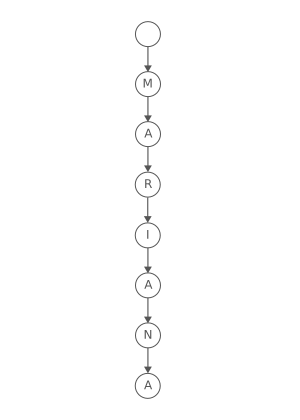
That's confusing ... it looks like we only have one word ("Mariana") even though we inserted two.
To avoid this, most tries append a special character to every word as a "flag" for the end of the word.
Let's use "." as our "end of word" marker. Here's what our trie looks like now.
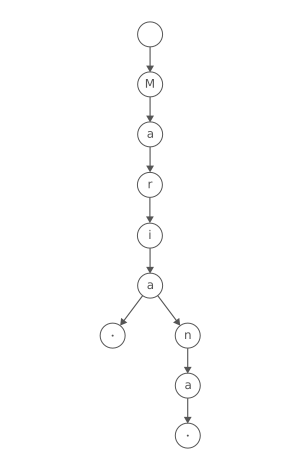
Now we can see that "Maria" is an actual item in our trie, not just a prefix for "Mariana".
Trie vs. Hash Table (Hash Set)
Say you were implementing a spell checker. You'll look for each word to see if it appears in Merriam-Webster's dictionary.
You could put all the dictionary words in a trie. Or, you could put them in a set.
Both options have the same average-case lookup complexity: , where k is the number of characters in the lookup string:
- For the trie, you'd have to walk from the root of the trie through k nodes, one character at a time.
- For the hash set, you have to compute a hash value from all k characters of the string in order to index into the underlying array.
So, if they have the same complexity, which one should you use?
Use a trie if you want to quickly find words starting with the same prefix. In our spell checker, this might be useful for suggesting corrections (i.e.: fixing "chocolatr" to "chocolate"). The only way to do this with a hash set would be to iterate through all the words, in time.
Use a hash set if you just need to check if a string is present or you're optimizing for space. In most cases, a hash set will take up fewer bytes than a trie. And, hash set lookups will probably be faster than trie lookups—trie nodes can be scattered throughout memory, which isn't cache friendly.
Hash sets aren't cache-friendly either. But with a hash set, you usually make one non-sequential memory lookup, versus k of them with a trie. (Here, k is the number of characters in the string.)
Here's the comparison at a glance:
| Trie | Hash set | |
|---|---|---|
| Is this word stored? | O(k) | O(k) on average (to hash the word) |
| Which words start with this prefix? | Fast: walk down the prefix, then look only at the words below it | Slow: check every word |
| Space | Usually more (a pointer for every link between nodes) | Usually less |
| Built into most languages? | No | Yes |
Radix Trees
A radix tree is like a trie, but it saves space by combining nodes together if they only have one child.
Here's what a radix tree with "Maria", "Mariana", and "David" looks like.
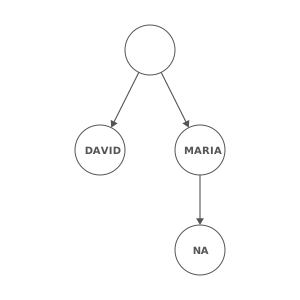
Notice how it has way fewer nodes and links than the trie version we looked at above.
Radix trees are more cache friendly than tries, since the characters within a single node are usually stored in an array of characters, adjacent to each other in memory.
Curious about other variations on tries? Check out ternary search trees, HAT-tries, and burst tries for lots more optimizations.
Interview coming up?
Get the free 7-day email crash course. You'll learn how to think algorithmically, so you can break down tricky coding interview questions.
No prior computer science training necessary—we'll get you up to speed quickly, skipping all the overly academic stuff.
No spam. One-click unsubscribe whenever.
You're in! Head over to your email inbox right now to read day one!