Memoization

In short: Memoization speeds up a function by caching its results, so when it's called again with the same inputs it returns the stored answer instead of recomputing. It's the core technique behind top-down dynamic programming.

Memoization ensures that a function doesn't run for the same inputs more than once by keeping a record of the results for the given inputs (usually in a dictionary).

For example, a simple recursive function for computing the nth Fibonacci number:

def fib(n): if n < 0: raise IndexError( 'Index was negative. ' 'No such thing as a negative index in a series.' ) elif n in [0, 1]: # Base cases return n print "computing fib(%i)" % n return fib(n - 1) + fib(n - 2)

Will run on the same inputs multiple times:

>>> fib(5) computing fib(5) computing fib(4) computing fib(3) computing fib(2) computing fib(2) computing fib(3) computing fib(2) 5

We can imagine the recursive calls of this function as a tree, where the two children of a node are the two recursive calls it makes. We can see that the tree quickly branches out of control:
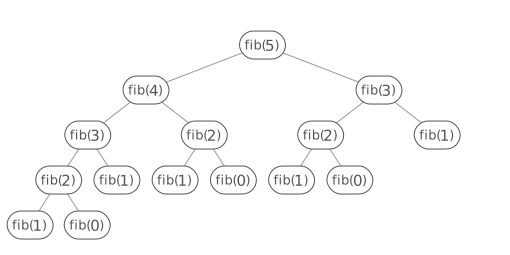
A binary tree showing the recursive calls of calling fib of 5. Every fib of n call calls fib of n minus 1 and fib of n minus 2. So calling fib of 5 calls fib of 4 and fib of 3, which keep calling fib of lower numbers until reaching the base cases fib of 1 or fib of 0.

To avoid the duplicate work caused by the branching, we can wrap the function in a class with an attribute, memo, that maps inputs to outputs. Then we simply

  1. check memo to see if we can avoid computing the answer for any given input, and
  2. save the results of any calculations to memo.
class Fibber(object): def __init__(self): self.memo = {} def fib(self, n): if n < 0: raise IndexError( 'Index was negative. ' 'No such thing as a negative index in a series.' ) # Base cases if n in [0, 1]: return n # See if we've already calculated this if n in self.memo: print "grabbing memo[%i]" % n return self.memo[n] print "computing fib(%i)" % n result = self.fib(n - 1) + self.fib(n - 2) # Memoize self.memo[n] = result return result

We save a bunch of calls by checking the memo:

>>> Fibber().fib(5) computing fib(5) computing fib(4) computing fib(3) computing fib(2) grabbing memo[2] grabbing memo[3] 5

Now in our recurrence tree, no node appears more than twice:
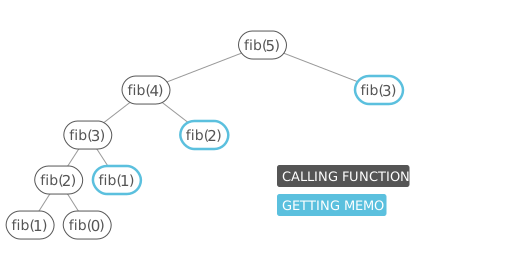
A binary tree showing the memos and recursive calls of calling fib of 5. Starting with the calls for fib of n minus 1, fib of 5 calls fib of 4, which calls fib of 3, which calls fib of 2, which calls fib of 1. then, for the fib of n minus 2 calls, fib of 5 gets the memo fib of 3, fib of 4 gets the memo fib of 2, fib of 3 gets the memo fib of 1, and fib of 2 calls fib of 0.

Memoization is a common strategy for dynamic programming problems, which are problems where the solution is composed of solutions to the same problem with smaller inputs (as with the Fibonacci problem, above). The other common strategy for dynamic programming problems is going bottom-up, which is usually cleaner and often more efficient.

Frequently Asked Questions

What is memoization?

Memoization is an optimization that stores the results of expensive function calls and returns the cached result whenever the same inputs occur again.

What's the difference between memoization and dynamic programming?

Memoization is top-down: you write the natural recursion and cache results. Dynamic programming usually refers to the bottom-up version that fills a table iteratively. Both avoid recomputing subproblems.

When should you use memoization?

When a recursive function repeatedly solves the same subproblems—like Fibonacci or many DP problems—memoization turns exponential work into linear or polynomial time.

Last updated: June 17, 2026

. . .