Interview Cake
 Depth-first search (DFS) is a method for exploring a tree or graph. In a DFS, you go as deep as possible down one path before backing up and trying a different one.
Depth-first search is like walking through a corn maze. You explore one path, hit a dead end, and go back and try a different one.
Here's a how a DFS would traverse this tree, starting with the root:
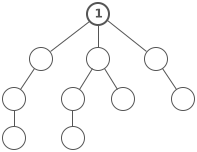
We'd go down the first path we find until we hit a dead end:
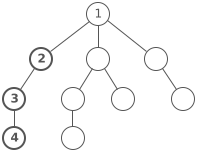
Then we'd do the same thing again—go down a path until we hit a dead end:

And again:

And again:
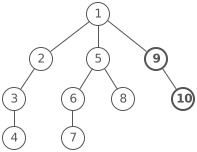
Until we reach the end.
Depth-first search is often compared with breadth-first search.
Advantages:
- Depth-first search on a binary tree generally requires less memory than breadth-first.
- Depth-first search can be easily implemented with recursion.
Disadvantages
- A DFS doesn't necessarily find the shortest path to a node, while breadth-first search does.
Interview coming up?
Get the free 7-day email crash course. You'll learn how to think algorithmically, so you can break down tricky coding interview questions.
No prior computer science training necessary—we'll get you up to speed quickly, skipping all the overly academic stuff.
No spam. One-click unsubscribe whenever.
You're in! Head over to your email inbox right now to read day one!