Interview Cake
Quick reference
| Complexity | |
|---|---|
| Worst case time | O(n log n) |
| Best case time | O(n log n) |
| Average case time | O(n log n) |
| Space | O(n) |
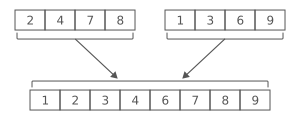
Merge sort is a divide-and-conquer sorting algorithm that splits an array in half, recursively sorts each half, and then merges the two sorted halves back together. It takes O(n log n) time in the best, average, and worst cases, and it's a stable sort, but it needs O(n) extra space.
Strengths:
- Fast. Merge sort runs in , which scales well as n grows.
- Parallelizable. Merge sort breaks the input into chunks, each of which can be sorted at the same time in parallel.
Weaknesses:
- Space. Merge sort takes up extra space, including space for the recursive call stack.
The High-Level Idea
Merge sort is a recursive algorithm that works like this:
- split the input in half
- sort each half by recursively using this same process
- merge the sorted halves back together
Like all recursive algorithms, merge sort needs a base case. Here, the base case is an input array with one item. A one-element array is already sorted.
Splitting the Input
Here's a visual representation of merge sort repeatedly breaking the input array in half:
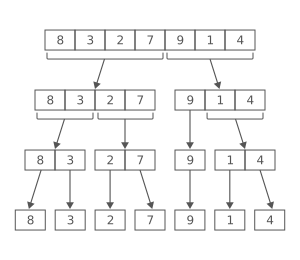
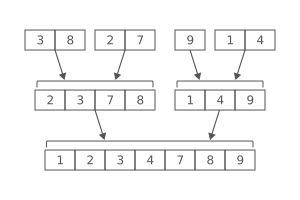
At the bottom, we've got a bunch of "sorted" one-item arrays that we want to combine into one large sorted array.
Merging sorted arrays
Combining two one-item arrays is easy—the smaller item goes first and the larger item goes second.
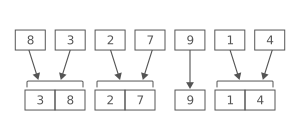
Now, how do we merge two of these two-item arrays?
That's a bit trickier, and it definitely requires more than one comparison.
Let's come up with a more general algorithm that can merge two sorted arrays of any size.
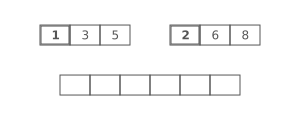
Take this example:
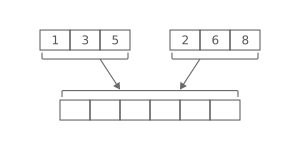
The smallest item has to be the first item in either the first array or the second array. So, we compare the first element in both arrays and place the smaller of the two at the front of the merged array.
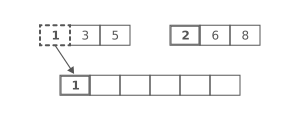
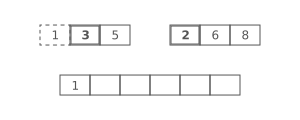
We can keep repeating this process, skipping over any items that we've already added to the merged array. At each step, we'll just compare the earliest unmerged items from both arrays and add the smaller one.
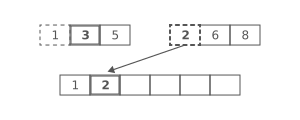
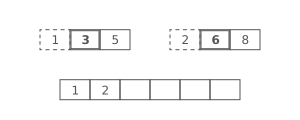
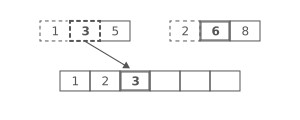
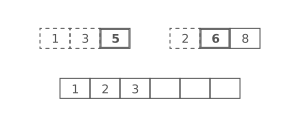
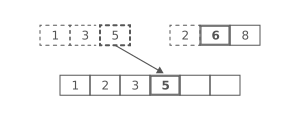
Once we exhaust one array, we can just append any remaining items from the other one to the end of the merged array.
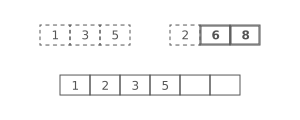
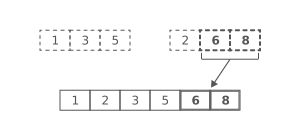
Using this more general approach, we can easily combine our two-element arrays into four-element arrays, combine those into eight-element arrays, and so on, until all the items are in a single, sorted array.
Implementation
Here's how we'd code it up:
Execution Order
We described merge sort as two steps: a splitting step and a merge step.
In reality, these steps are interleaved through recursive calls.
When we split the input into two arrays, we'll actually finish sorting the left half (splitting it all the way down to one-element arrays and merging them back together) before we even touch the right half.
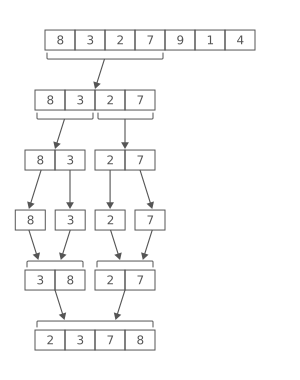
Then, we'll do the same thing with the right half before combining both sorted halves together to get the full sorted array.
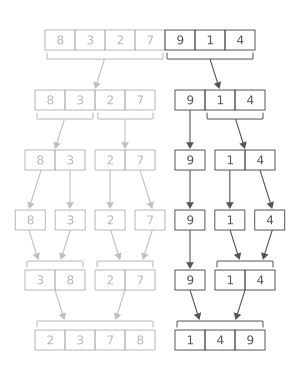
Understanding the actual execution order is important for thinking through the space cost on the call stack.
Time Complexity
Look at each row in the execution diagram:
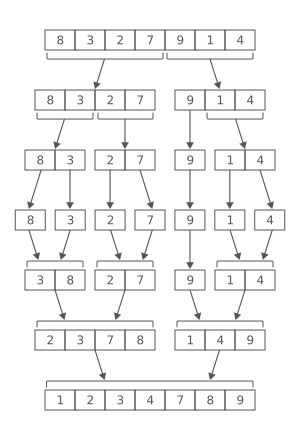
Each row in the diagram is time.
- In the upper half, we do some constant-time work for each item by copying the item from the input array into a smaller array.
- In the bottom half, we do some constant-time work for each item by copying the item from a smaller, sorted array into the larger, merged array.
How many rows are there in the diagram? In the top half, we're dividing n in half until we get down to 1. Then, in the bottom half we do the reverse—multiplying by two until we get to n. That's divisions followed by multiplications.. Adding the two together, we've got levels.
So overall, merge sort takes time.
Space Complexity
When combining two sorted arrays into a single bigger one, we need scratch space to hold the merged result.
Since the arrays we'll be combining have items, we'll need space in total.
But, don't we need less than space for some of the merges?
Yes. For instance, when we're merging two arrays with one element each, that requires space.
But, by the time we get to the final merge, we'll have two halves that each have n/2 items, so we'll need space for the combined result.
Do we really need that scratch space? Can't we just be more clever about how we merge the sorted arrays?
Try for yourself! Turns out you can't really do the merge in space without bumping up the time complexity.
If you look carefully, our implementation allocates more memory than is strictly necessary.
In the arguments for each recursive call, we're passing in a copy of half of the input. Over the whole sort, those copies add up to allocated space. (Only of it is in use at any one time, since each level's copies are half the size of the level above.)
We did this to keep the implementation nice and tidy (and not distract from the key intuition behind merge sort).
But with some cleverness, you can get away with allocating a single scratch array up front and reusing it. Try it. :)
Merge Sort vs. Quicksort
Merge sort and quicksort are both divide-and-conquer sorts that average O(n log n) time, but they make different trade-offs:
| Merge sort | Quicksort | |
|---|---|---|
| Worst-case time | O(n log n) | O(n²) |
| Average time | O(n log n) | O(n log n) |
| Extra space | O(n) | O(log n) on average, for the recursion |
| Stable? | Yes | No (not the usual in-place versions) |
| Where the work happens | Merging the sorted halves | Partitioning around a pivot |
Quicksort is usually faster in practice on arrays, since it sorts in place and moves through memory in a cache-friendly way. Merge sort is the safer pick when you need a guaranteed O(n log n) worst case or a stable sort, or when you're sorting a linked list or data that's too big to fit in memory.
Plenty of standard libraries use both. Java, for example, sorts arrays of primitives with a variant of quicksort and sorts arrays of objects with Timsort, a stable sort built on merge sort.
Interview coming up?
Get the free 7-day email crash course. You'll learn how to think algorithmically, so you can break down tricky coding interview questions.
No prior computer science training necessary—we'll get you up to speed quickly, skipping all the overly academic stuff.
No spam. One-click unsubscribe whenever.
You're in! Head over to your email inbox right now to read day one!